

Scoliosis assessment and treatment
Skolioza?
Assess it early.
Scoliosis often appears during growth and may affect posture and the way the body moves. We begin with a detailed assessment to understand the condition and needs of each patient.
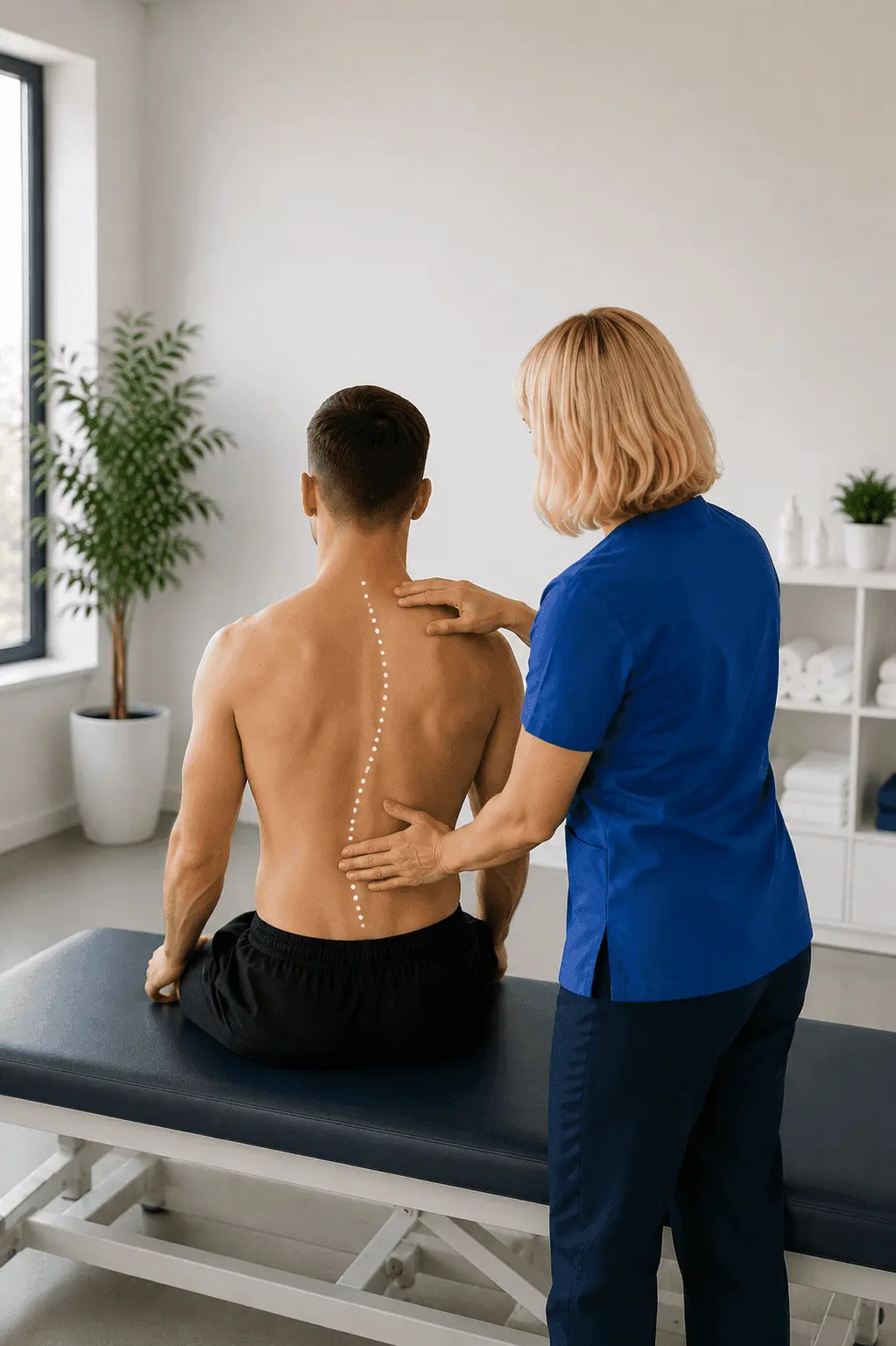
What is scoliosis?
A spinal curvature that should be monitored
Scoliosis is a sideways curvature of the spine that may also involve rotation of the vertebrae. It often develops gradually during growth.
It may be mild or more pronounced. In some cases it does not cause pain, but it may affect body symmetry, posture and movement control.
Common signs
What might you notice?
Scoliosis may appear as subtle changes in posture, which may become more noticeable during growth.
Uneven shoulders
One shoulder may appear higher than the other.
Waist asymmetry
One side of the waist may appear more pronounced.
Back asymmetry
One side of the back may appear more prominent when bending forward.
Pelvic asymmetry
One side of the pelvis may appear higher.
Posturel asymmetry
The body may appear tilted or uneven.
Back fatigue
Fatigue or tension after prolonged sitting or standing.
Who is most commonly affected?
Scoliosis is often detected during growth
Many cases of scoliosis appear in children and adolescents. Because the body is still developing, monitoring during growth is particularly important.
Children during growth
Adolescents with postural changes
People with visible body asymmetry
Adults previously diagnosed with scoliosis
People with persistent back fatigue or tension
Scoliosis progression
Can scoliosis progress?
In some cases, yes.
The risk of progression may be higher during periods of rapid growth. For this reason, periodic assessment helps determine whether the condition is changing.
Not every case of scoliosis progresses in the same way. An individual assessment helps determine the appropriate plan and monitoring frequency.
Assessment at Treka Fizio
What do we assess?
The assessment does not focus only on the shape of the spine, but also on how the body stands and moves.
Posture
We observe the symmetry of the shoulders, pelvis and waist, as well as overall body position.
Movement
We assess spinal mobility and body control.
Strength
We assess the muscles of the trunk, back and other areas that contribute to stability.
Progress
We compare changes over time and adapt the program when needed.
Treatment at Treka Fizio
How is scoliosis treated?
The program is tailored according to age, condition, posture, activity level and stage of growth.
Specific exercises
Exercises tailored to the pattern of the curvature and the way the body is controlled.
Postural retraining
We work to improve awareness and control of body position.
Strengthening
We strengthen the trunk muscles and other areas that support control and stability.
Monitoring
We monitor progress and adapt the program during growth or as the condition changes.
Early assessment
Why is early assessment important?
When scoliosis is detected during growth, there is more opportunity to monitor changes and introduce an appropriately tailored program.
The goal is not simply to change posture, but to improve body control, strength, movement and the way the patient manages the condition.
Why Treka Fizio?
A program tailored to each patient
Each patient is assessed individually. The program is tailored according to age, stage of growth, posture, movement and progress during treatment.
Learn more about usDetailed posture assessment
Individual program ushtrimesh
Postural retraining
Ongoing monitoring
Home exercises
First step
Have you noticed changes in posture?
Book an appointment if you have noticed asymmetry in the shoulders, back or pelvis, or if you would like to have the posture of your child assessed during growth.
Book an AppointmentWe assess symmetry, movement and body control.
Exercises tailored to the patient’s condition.
We adapt the program according to changes during treatment.
Frequently asked questions
Questions about scoliosis
Can scoliosis progress? +
In some cases, yes, particularly during periods of rapid growth. For this reason, periodic assessment and monitoring are important.
Can physiotherapy help with scoliosis? +
Physiotherapy can help improve posture, strength, body control and management of the condition. The program should be tailored to the individual.
Should scoliosis be assessed even when there is no pain? +
Yes. Scoliosis can be present even without pain. An assessment helps clarify the condition and whether monitoring or treatment may be appropriate.
At what age should posture be assessed? +
Posture can be assessed when changes in body symmetry are noticed, especially during periods of growth in children and adolescents.
How long does scoliosis treatment take? +
The duration depends on age, stage of growth, the condition, individual goals and response to the exercise program.