

Movement Check-Up Protocol
See the tests included in the Movement Check-Up.
Everyone who completes the Movement Check-Up at Treka Fizio follows the same core testing protocol.
This helps us build a complete and comparable picture of how your body moves.
How does the protocol work?
The same tests.
Individual interpretation.
The core protocol is the same for everyone. You complete the same group of tests assessing different areas and movements of the body.
The results are always interpreted in the context of your condition, history, activity level and goals.
Before you begin
How are the tests performed?
The tests are simple and performed under the guidance of your physiotherapist. No sensors or devices are attached to your body.
We explain the movement
Before each test, your physiotherapist shows you how to perform the movement.
You position yourself in front of the system
You stand in the position and at the distance indicated by your physiotherapist.
You perform the test
You perform the movement at a controlled pace, following the instructions provided.
We analyze the results
Your physiotherapist reviews the measurements and considers them alongside your clinical assessment and history.
The protocol step by step
Movement Check-Up tests
These are the core tests completed by everyone during the Movement Check-Up.
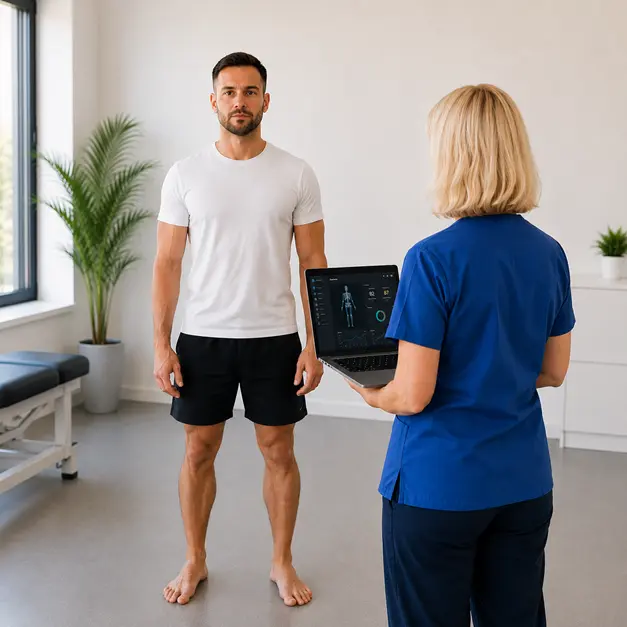
Posture
What will you do?
You will stand upright and relaxed for a few seconds, in the position indicated by your physiotherapist.
What do we analyze?
We look at how the main parts of the body are positioned, including symmetry and visible differences between sides.
Result view
What will you see in the system?
A system view will be displayed here showing body positioning during the test.
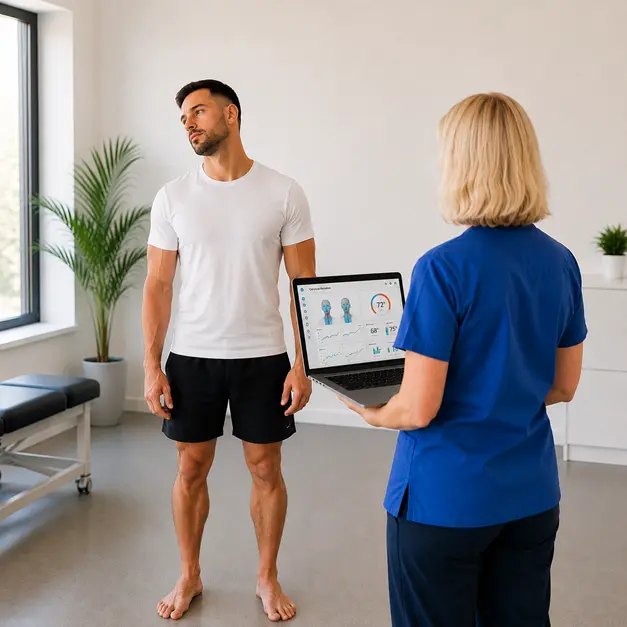
Neck mobility
What will you do?
You will move your head forward, backward, sideways and turn left and right, following your physiotherapist’s instructions.
What do we analyze?
We measure how far your neck moves in each direction and compare movement between the left and right sides.
We also look at whether you use your trunk to compensate for limited neck movement.
Result view
What will you see in the system?
The result may show your range of motion and differences between left and right movement.
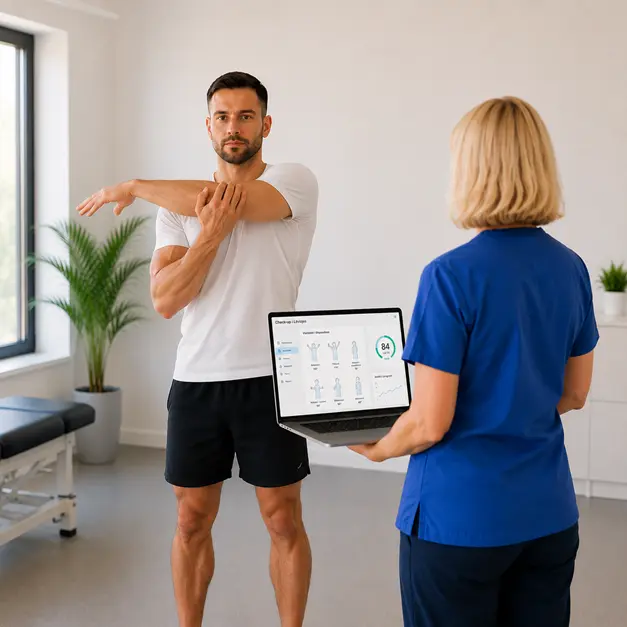
Shoulder mobility
What will you do?
You will raise and move your arms in several directions, following your physiotherapist’s instructions.
What do we analyze?
We assess the range of motion, differences between the two shoulders and whether your body uses other movements to compensate for a limitation.
Result view
What will you see in the system?
The result may show the angle of movement and the comparison between the left and right shoulder.
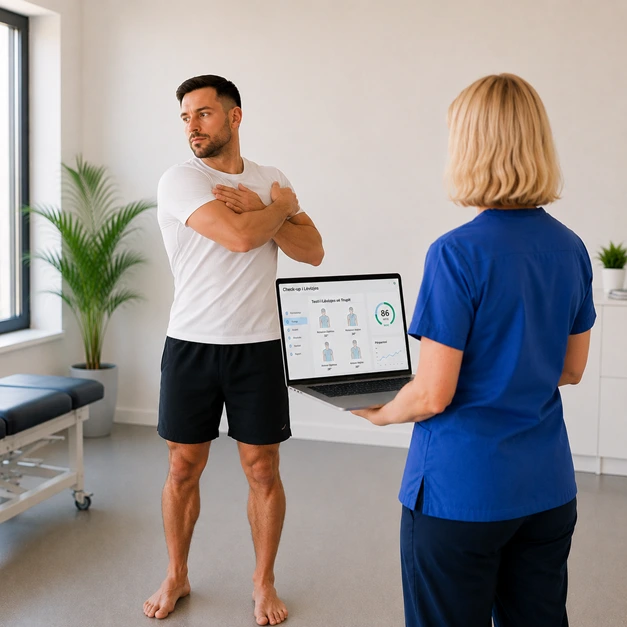
Trunk mobility
What will you do?
You will bend forward and sideways and rotate your trunk in a controlled manner.
What do we analyze?
We assess trunk mobility, differences between the two sides and how different parts of the body work together during movement.
Result view
What will you see in the system?
The result may show the range of bending, side bending and trunk rotation.
Squat
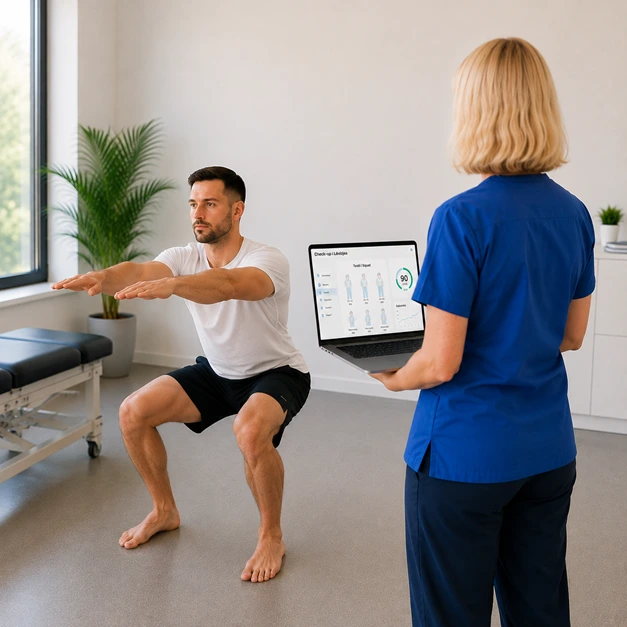
What will you do?
You will lower yourself and stand back up in a controlled way, as if sitting down on a chair.
What do we analyze?
We look at how the trunk, hips, knees and ankles work together during the movement.
- Trunk control.
- Knee position.
- Hip movement.
- Differences between sides.
- Compensations while lowering and rising.
Result view
What will you see in the system?
The view may show the position of the trunk, hips and knees at different points during the movement.
Single-leg balance
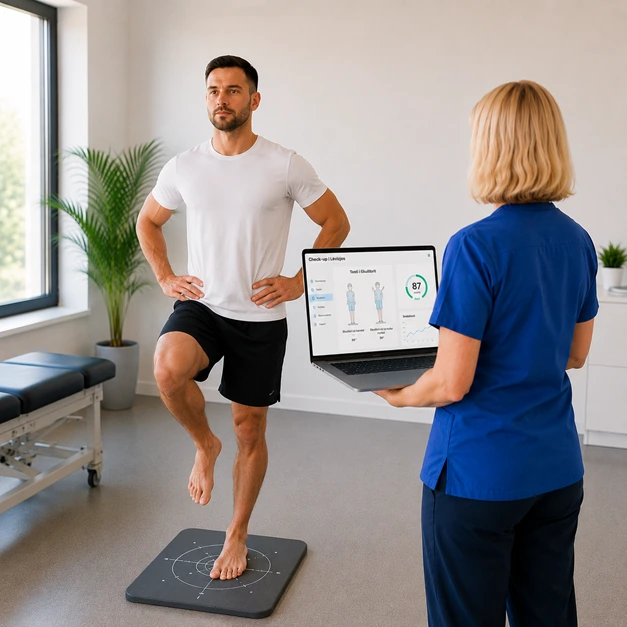
What will you do?
You will stand on one leg for several seconds and then repeat the test on the other leg.
What do we analyze?
We assess how you maintain balance and how stable your body is, including any differences between the left and right sides.
We also analyze the position of the trunk, pelvis and knee while standing.
Result view
What will you see in the system?
The result may show body control and differences between standing on the left and right leg.
Sit-to-stand
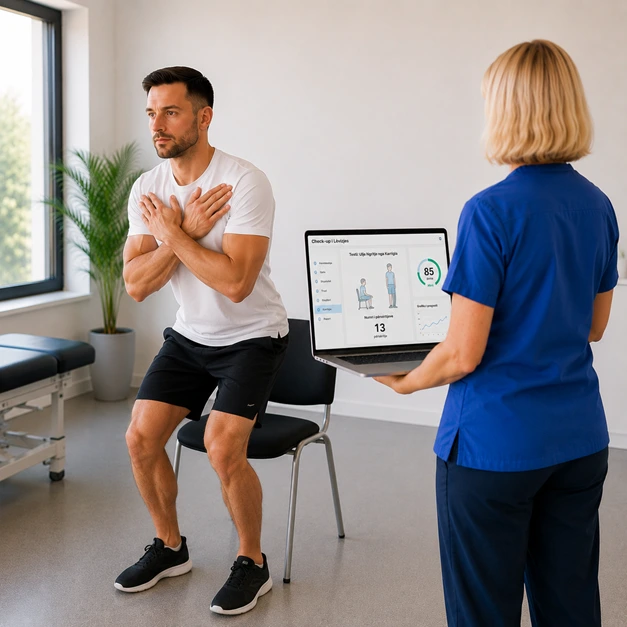
What will you do?
You will sit down and stand up from a chair following your physiotherapist’s instructions.
What do we analyze?
We look at how you initiate the movement, trunk control and how you use both legs while sitting down and standing up.
This is a functional test because it reflects a movement you frequently use in everyday life.
Result view
What will you see in the system?
The result may show how movement is distributed movement during sitting down and standing up.
After the tests
What do the results show?
After completing the protocol, the results help us build an overall picture of how your body moves.
Mobility in different areas
Differences between sides
Balance
Body control
Compensations during movement
A baseline for comparing progress
An important clarification
Results are not interpreted in isolation.
A difference between sides or a limited movement does not automatically mean that we have identified the cause of a problem.
The results are interpreted by your physiotherapist together with your history, symptoms, activity and clinical assessment.
When more information is needed
Additional tests when needed
The core Check-Up protocol is the same for everyone.
If your results or symptoms require a more specific analysis, your physiotherapist may recommend additional tests related to a particular area, an injury, return to sport or monitoring recovery.
Additional tests are not automatically part of the core protocol.
After the Check-Up
What do you receive after the protocol?
The test results become part of your report and shpjegohen nga your physiotherapist.
Test results
Physiotherapist’s explanation
Personalized report
Comparison between sides
Recommendations for next steps
A baseline for comparing progress
Movement Check-Up
Would you like to complete a Movement Check-Up?
The testing protocol is part of the complete Movement Check-Up, together with a professional assessment, interpretation of your results and a personalized report.